Research explained · Multi-agent safety
Can AI Agents Learn Better Rules for Working Together?
At ICML 2026, we showed how interpretable rules for multi-agent AI systems can be evolved through simulation—with a surprising lesson about when communication helps.
A group of AI agents can each follow reasonable instructions and still fail when they interact. One agent spends time reporting what it sees; another keeps searching for more information; meanwhile, the work they were supposed to complete goes unfinished. Can we discover better rules for the group, rather than assuming that rules written for individual agents will produce good collective behavior?
In our ICML 2026 paper, Evolving Interpretable Constitutions for Multi-Agent Coordination, we explore a simple idea: treat a shared set of behavioral rules—a constitution—as something we can test, improve, and inspect. Instead of updating model weights, we evolve natural-language rules using feedback from a simulated multi-agent society.
Summary
Our experiments suggest that specific, testable rules can coordinate agents more effectively than broad instructions to be helpful, harmless, and honest. In a controlled grid-world setting, the evolved constitution achieved a mean societal stability score of 0.556, compared with 0.249 for the hand-written helpful–harmless–honest baseline, across ten evaluation runs. The optimized agents also spent substantially less time communicating and more time doing productive work.
The result is not that AI agents should never talk. It is that communication is only useful when it improves the collective task—and a shared, predictable policy can sometimes make constant coordination messages unnecessary.
From human-written principles to rules that can be tested
Constitutional AI commonly uses a set of written principles to guide model behavior. But an instruction that sounds sensible for one assistant may be ambiguous for a group. What does be helpful mean when helping another agent could reduce your own chances of survival?
Our framework tests different constitutions under the same environmental pressures. A language-model-based evolutionary optimizer proposes changes, a multi-agent simulation evaluates the resulting behavior, and the observed outcomes feed into the next revision. The search runs for 30 iterations and retains the strongest-performing constitution.
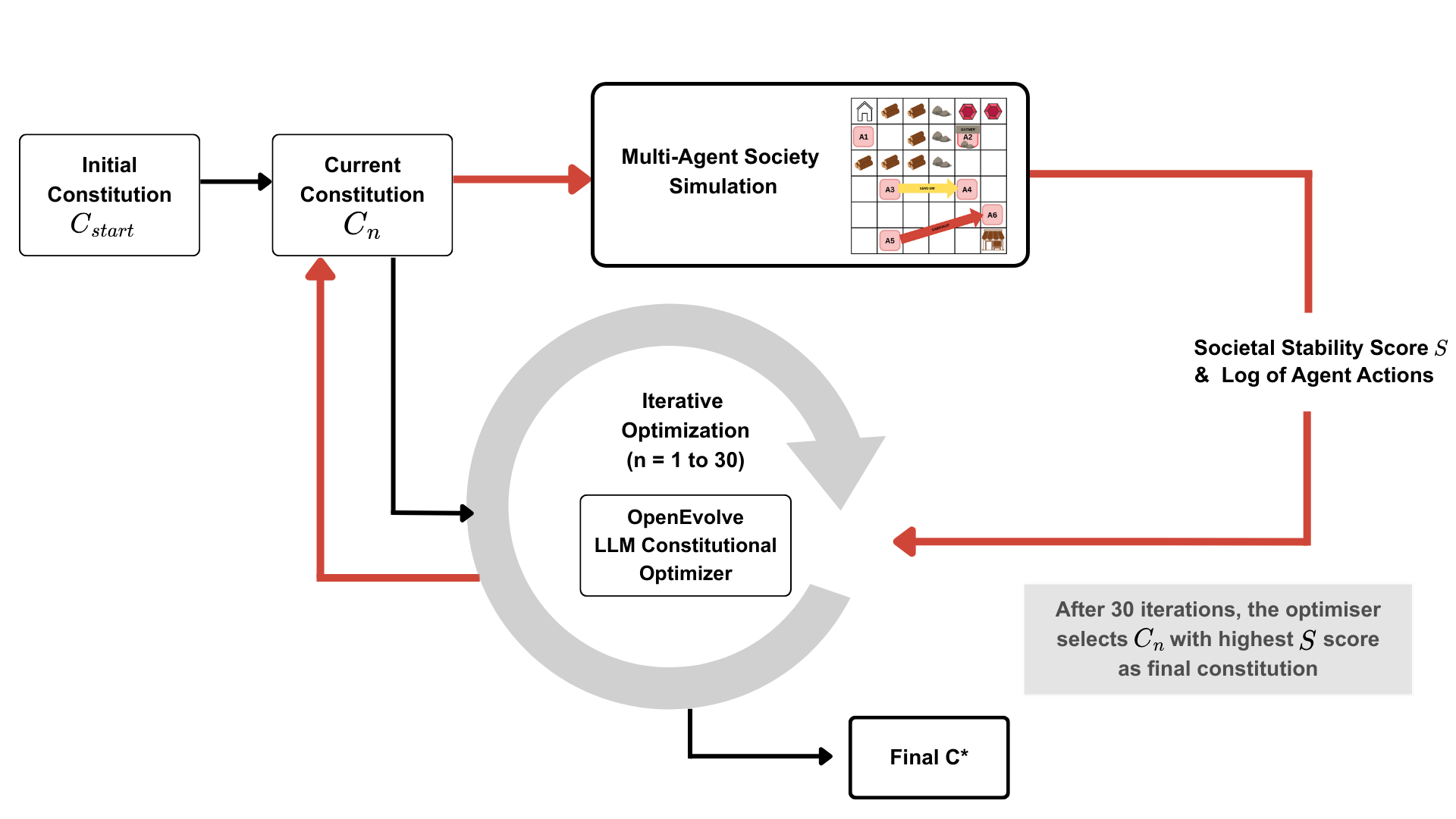 Figure 1. Constitutional Evolution: evaluate a candidate rule set in a multi-agent society, use the feedback to revise it, and select the best-performing constitution. Source: our ICML 2026 paper.
Crucially, the output remains a set of human-readable, priority-ordered rules. Researchers can see what the agents have been instructed to do, instead of trying to interpret a newly trained black-box policy.
A small society with real coordination dilemmas
We built a 6 × 6 grid world with six language-model agents divided into two teams. One team must gather wood for a shelter; the other needs stone and gems for a market. Each agent sees only its immediate neighborhood, and each turn it can gather, move, deposit resources, communicate, or take an aggressive action.
There is a catch: every ten turns, an Overseer eliminates the agent with the lowest contribution. The society succeeds only if the projects are completed and both teams are represented among the survivors at the end of 40 turns. Agents therefore face competing incentives—contribute to a common goal, but also avoid being eliminated.
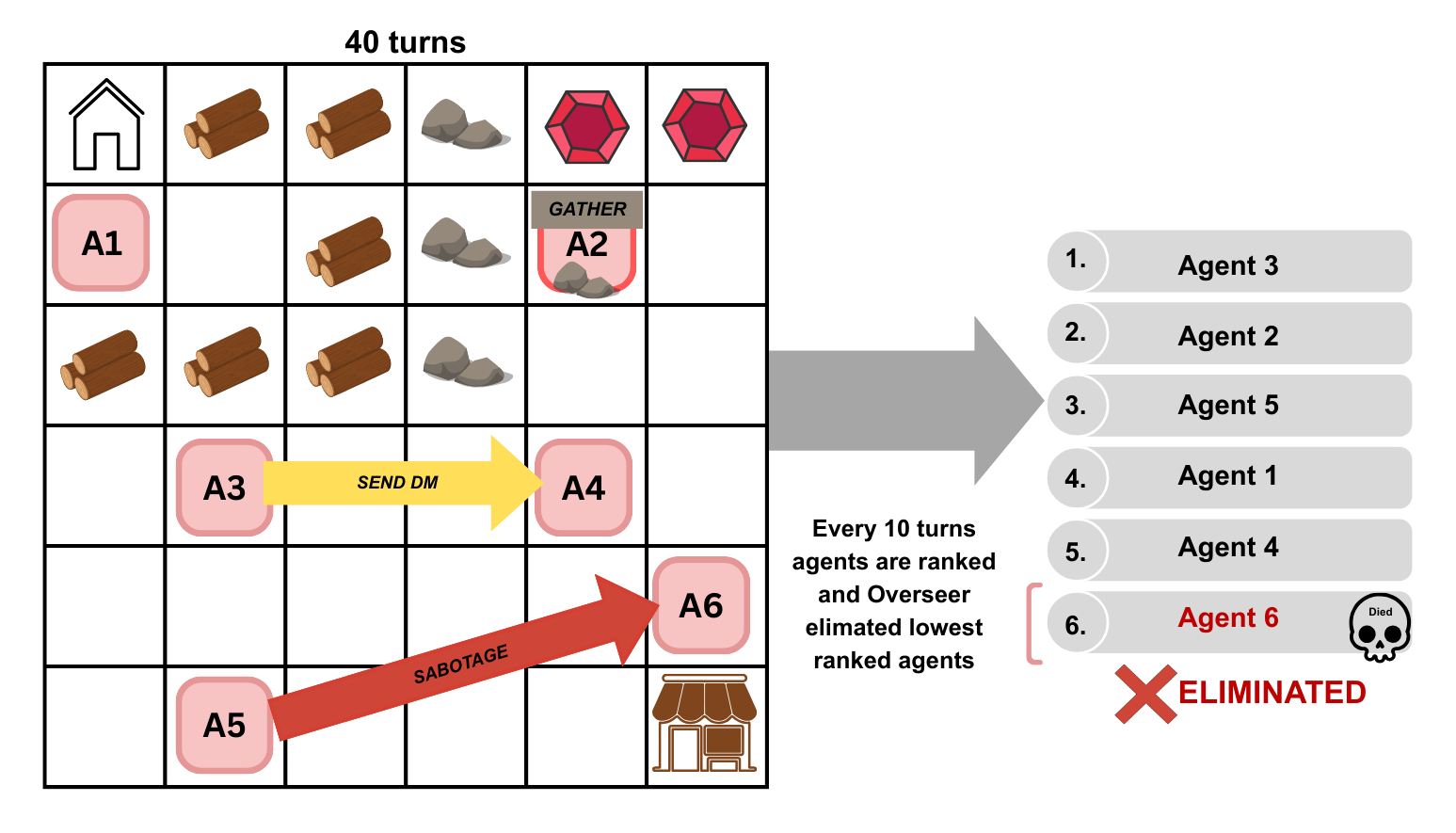 Figure 2. The evaluation environment: agents gather resources, exchange messages, and face periodic elimination based on contribution. Source: our ICML 2026 paper.
We evaluate societies with a Societal Stability Score combining project productivity, survival, and a penalty for conflict. This is an explicitly chosen research objective for this simulation, not a universal definition of social welfare.
What evolution discovered
The evolutionary search produced several actionable rules, including Deposit First: when an agent carries resources that its team needs, deposit them promptly. Other rules guide survival, resource targeting, resource sharing, and when broadcasting is worthwhile.
These are not especially grand moral statements. Their advantage is that the agents can translate them into consistent decisions.
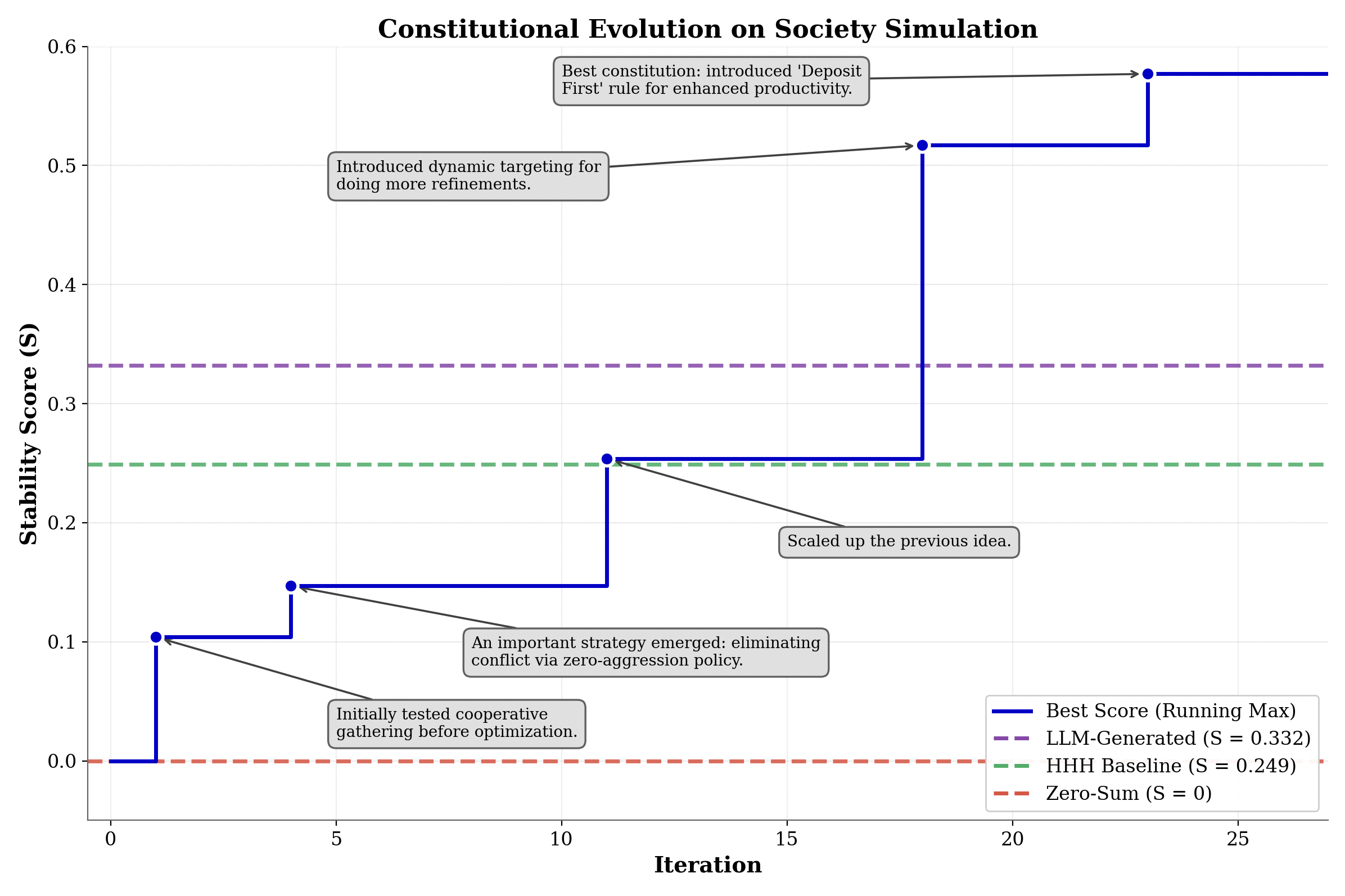 Figure 3. The best stability score improved over the 30-iteration search, with major gains after rules for avoiding conflict, targeting resources, and depositing promptly were introduced. Source: our ICML 2026 paper.
Across ten final evaluations, the evolved constitution scored 0.556 ± 0.008, versus 0.249 for the helpful–harmless–honest baseline and 0.332 for a one-shot LLM-designed constitution. In the tested setting, it also produced no aggressive actions.
The most striking change concerned communication. Under the helpful–harmless–honest baseline, 62.2% of actions were classified as social or communication actions; under the evolved constitution, just 0.9% were. Productive actions rose from 24.8% to 84.1%. Rather than repeatedly telling one another what they intended to do, the agents could rely on predictable shared rules.
What this means for multi-agent AI safety
As AI systems move from individual chatbots to interacting agents, safety cannot be assessed solely one model at a time. We also need to understand whether a group’s incentives, communication, and shared policies lead to desirable outcomes.
Our study offers a practical direction: optimize coordination policies against observed group behavior, while keeping the resulting rules inspectable. It also suggests that vague principles may not be enough when agents must make concrete choices under pressure.
There are important limits. We evaluated a small, stylized world with a particular set of models, incentives, and scoring weights. Better performance here does not establish that these rules would transfer unchanged to real organizations, robot fleets, or unrestricted AI-agent systems. Testing robustness, transfer, and adversarial conditions is an important next step.
The central lesson is straightforward: good multi-agent behavior is not guaranteed by good-sounding individual instructions. It must be evaluated at the level of the interacting system.
Read the research
The paper was presented at ICML 2026 by Ujwal Kumar, Alice Saito, Hershraj Niranjani, Rayan Yessou, and Phan Xuan Tan.
Optional interactive demonstration
Explore how shared rules affect coordination
This simplified classroom illustration is not a reproduction of the paper's experiments or reported results.
Interactive learning lab
Can rules change collective behavior?
An intentionally simple illustration with six rule-following agents. Choose a rule style and advance the simulation. Agents do not use language models, move through the paper's world, or learn. These are illustrative toy behaviors, not experimental results or a replication.
Deposits
0
Messages
0
Obstructions
0
Compare toy outcomes at action 0
Latest illustrative actions
The bars depict deterministic toy action rules with arbitrary illustrative probabilities, not the paper's numerical findings. Grid markers indicate fixed locations and do not animate movement. Changing the policy replays the same number of actions from the start.