Research explained · Mechanistic interpretability
Can We See Inside a Language Model Through Pixel Art?
Pixel Auto-Encoder turns internal language-model activations into small images and back again. Experiments reveal both the promise of visual interventions and the gap between visual readability and computational faithfulness.
Imagine a language model completing the sentence “My favorite animal is the”. Instead of editing the prompt, what if we could change a small image inside its computation — and thereby change the next word it predicts?
In our preprint, Pixel Auto-Encoder: Reconstructing Language Model Activations Through Pixel Art, Haru Furuichi and Phan Xuan Tan explore images as an alternative medium for interpreting the internal representations of large language models (LLMs).
The question: can a picture carry a model's computation?
Internal activations are high-dimensional numerical vectors. Translating them into a form humans can inspect is an important challenge in interpretability. Inspired by Natural Language Autoencoders and concept bottleneck models, we investigate whether visual representations can serve a similar purpose.
The challenge is not simply to draw a picture of an activation. The image must carry information that the model needs for subsequent computation. A representation that is easy to recognize may not preserve everything the model uses.
From activations to pixel art — and back
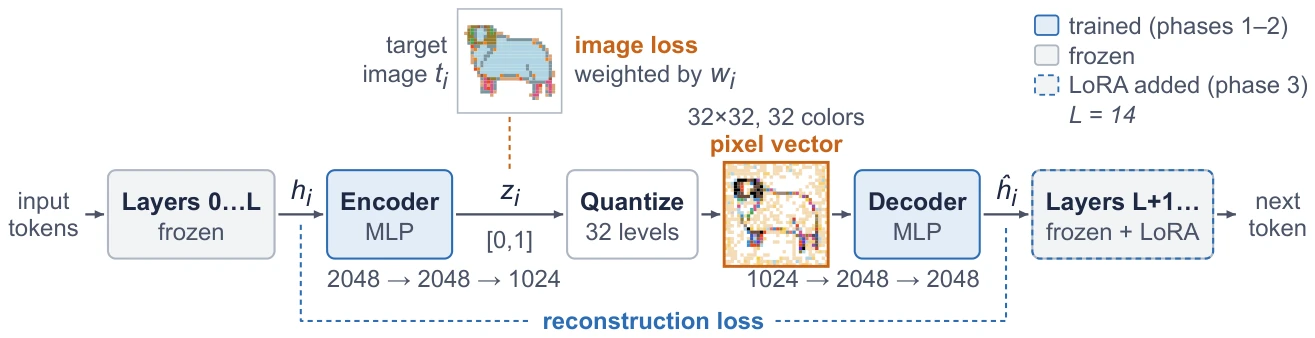
Figure 1. Architecture of the Pixel Auto-Encoder, reproduced from the original paper.
We insert an encoder and decoder at the output of layer 14 (zero-indexed) of LFM3-1.7B, a 24-layer language model. The encoder converts a 2,048-dimensional residual-stream activation into 1,024 values, quantized to 32 levels and arranged into a 32 × 32 image with 32 colors. The decoder reconstructs the activation, which is passed to the remaining layers.
To encourage recognizable images, we use 1,613 predefined concept images from Mulberry Symbols. Concept vectors are constructed from model activations associated with specified word senses. The closest concept in whitened activation space supplies the target image; ambiguous or weak matches receive less supervision. These images are learned targets, not unrestricted pictures of the model's thoughts.
Training has three stages:
- Reconstruction: Train the encoder and decoder to preserve activations through the pixel bottleneck.
- Visual alignment: Add a weighted image-matching loss alongside the reconstruction loss. Adjust the image-loss coefficient to balance the two objectives.
- Downstream adaptation: Freeze the encoder, decoder and earlier model layers, then adapt layers 15–23 with LoRA to reduce the divergence from the original model's next-token distribution.
What did the experiments reveal?
The evaluation uses 220 held-out English Wikipedia articles, containing 326,916 tokens.
Finding 1: the bottleneck itself is not the main source of degradation. Before downstream adaptation, the reconstruction-only control has perplexity 20.8 and KL divergence 0.118 relative to the base model (perplexity 19.5). Adding image supervision increases these values to 26.2 and 0.392, respectively. LoRA adaptation partially recovers performance, bringing perplexity to 24.5 and KL divergence to 0.310. These results suggest that forcing recognizable images, rather than the pixel format alone, accounts for much of the observed degradation.
Finding 2: some representations resemble the assigned concepts. The overall mean-subtracted cosine similarity to target images is 0.224, compared with -0.001 without image supervision. For positions in the highest decile of target-image weight, similarity reaches 0.614; at positions with zero weight it is 0.056. Stronger image supervision is also associated with higher reconstruction error. This suggests a trade-off between visual alignment and information preservation.
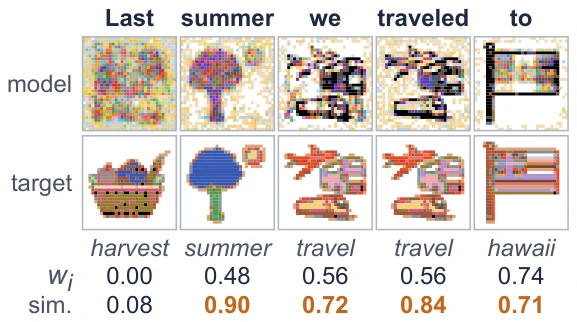
Figure 2. Original pixel vectors and assigned target images across a sentence, reproduced from the paper.
Finding 3: changing the picture can change the prediction. In the animal-sentence example in Figure 4, the original top candidate is “elephant” (probability 0.16). Replacing the pixel vector at the position of “the” with a bird, cat or milk concept image changes the top candidate to “bird” (0.11), “cats” (0.36) or “milk” (0.33), respectively. All other positions are unchanged in this intervention.
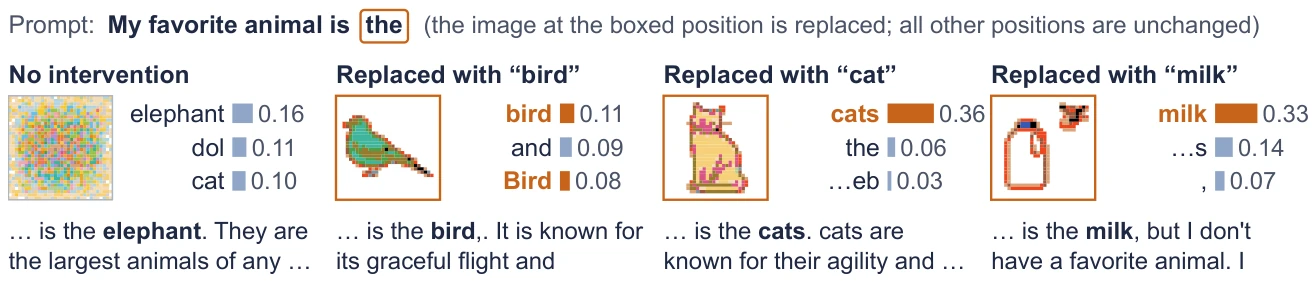
Figure 4. Original intervention examples, showing the top three next-token candidates and generated continuations.
Across 72 trials (18 concepts at each of four positions), the substituted concept word enters the top 10 in 37 trials and ranks first in 14 trials. This is evidence that image replacement can influence subsequent predictions, but it is not reliable concept-level control.
Finding 4: visual similarity does not guarantee computational similarity. For the positions in the highest decile of target-image similarity, randomly changing 1% of pixels reduces average similarity only from 0.898 to 0.880. Yet KL divergence increases from 0.653 to 1.385, and perplexity from 41.2 to 84.1. At 5% corruption, divergence rises to 3.591 and perplexity to 727. These measurements concern the selected positions, not whole-corpus perplexity.
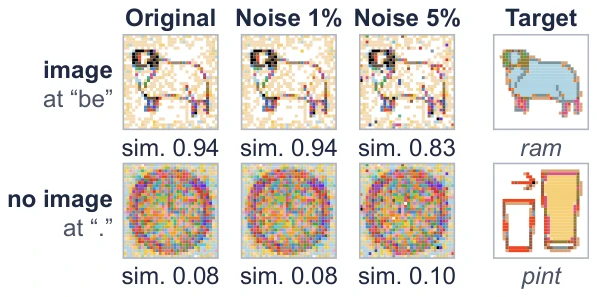
Figure 3. Original examples of random changes to 1% and 5% of pixels.
The model may rely on fine-grained information that humans do not readily see in an image. The experiments do not yet identify exactly how this information is encoded.
Watch the research demonstration
The accompanying video shows pixel representations during language generation and demonstrates interventions through concept-image replacement. It illustrates the method rather than establishing that every visual intervention works. See the video player below.
Why this matters for AI safety
A visualization can look convincing without providing a faithful explanation of a model's computation. This is a central challenge for interpretability-based monitoring and intervention.
Pixel Auto-Encoder offers a concrete way to investigate the tension between human-readable representations and computational fidelity. The ability to substitute a representation and measure its downstream effect is useful for studying causality, while the sensitivity to small pixel changes exposes an important limitation.
This is exploratory mechanistic interpretability research, not a validated safety monitor or a general-purpose control mechanism.
Limitations and future work
The current study uses one model, one bottleneck location, one training seed and a fixed vocabulary of 1,613 concept images. Concept-image interventions were evaluated at only four positions. Broader experiments are needed before generalizing these results.
Future work could explore richer visual representations, better reconstruction–interpretability trade-offs and tests of whether visually meaningful features faithfully reflect information used by subsequent model layers.
Paper: Pixel Auto-Encoder: Reconstructing Language Model Activations Through Pixel Art, arXiv v1, November 21, 2026.
Authors: Haru Furuichi and Phan Xuan Tan (Shibaura Institute of Technology).
Image dataset: Mulberry Symbols (CC BY-SA, as cited in the paper). Figures 1–4 are reproduced from the original preprint, with cropping and WebP encoding for web display; the scientific content has not been redrawn.
Research demonstration
Pixel Auto-Encoder in action
A short demonstration of pixel representations during text generation and concept-image intervention.
The demo video is not yet available in this preview.